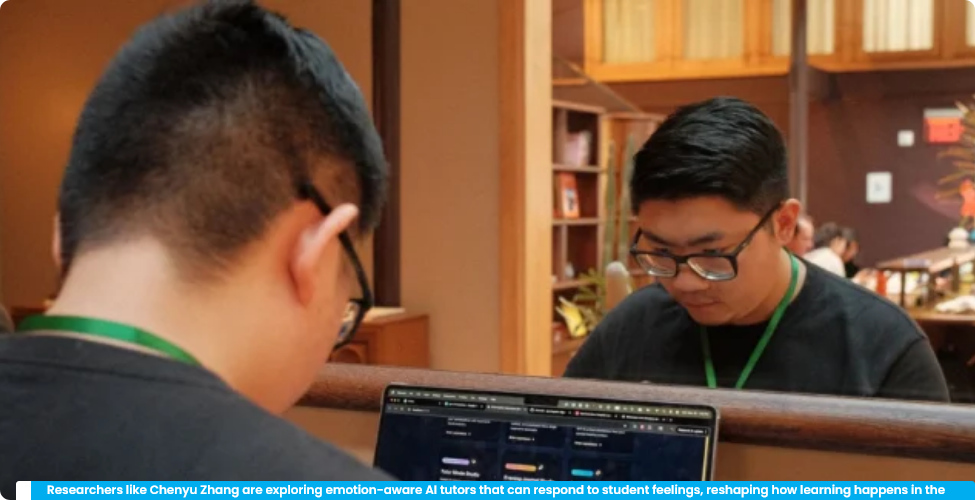
Students do not learn solely through logic. Frustration, curiosity, hesitation, and confidence can shape whether a lesson lands or slips away, yet most AI tutors still respond as if every learner were in the same state. Chenyu Zhang is part of a group of researchers asking whether educational technology can do more than deliver answers, whether it can sense emotion, respond with care, and make learning feel more attentive to the people using it.
That question has guided Zhang’s work across research and teaching. Based in Cambridge, he has held roles linked to Harvard’s Berkman Klein Center, MIT Media Lab, Stanford HAI, and the University of Georgia, while developing GlowingStar, a startup focused on emotion-aware tutoring. His academic path, from computer science at the University of Toronto to a Master of Education at Harvard, helps explain why his work sits so naturally between engineering and the lived realities of the classroom.
Where Feeling Meets Code
For years, AI tutors have excelled at speed. Feeling, though, remains the blind spot. Zhang’s ACII 2025 paper tackled that problem by studying affective dynamics in student-tutor dialogue across 16,986 turns from 261 learners at three U.S. institutions.
Rather than relying on a single large language model, the study used an ensemble, allowing several systems to weigh the same exchange and read mood with greater care. Curiosity, confusion, frustration, and recovery mattered because a wrong reply from a tutor can be more than a mistake; it can become the moment a learner decides a subject is no longer for them. Zhang’s premise is simple: a machine that misses emotion may miss the lesson, too.
“Dialogue is a dance of affect and intent. When AI joins that dance, we must teach it when to lead, when to listen.” That line carries the heart of his research. A tutor, human or digital, does more than deliver information. A tutor sets
Zhang’s recent roles suggest he knows that. At Harvard’s Berkman Klein Center, he has studied ways to steer agentic conversational AI through interpretable control dimensions tied to safety and controllability. At the same time, his current University of Georgia work examines how generative AI materials can be tested for clarity, engagement, and classroom usefulness.
GlowingStar’s ambition reaches well past schoolchildren. A recent talk description framed the tutor as a companion for working-class students and lifelong learners, drawing on signals from speech, facial microexpressions, response delay, and silence. That breadth matters. Adult learners carry different fears from teenagers. Many return to study after years away, already braced for failure. A system that can sense strain without shaming them could change whether they stay the course.
Schools have chased speed for years: faster grading, faster feedback, faster content. Zhang is chasing something slower and, for that reason, more daring: the pause before a learner quits. Overall, students learn best when they feel heard.
the pace, reads hesitation, and senses when a student needs a simpler way into the same idea.